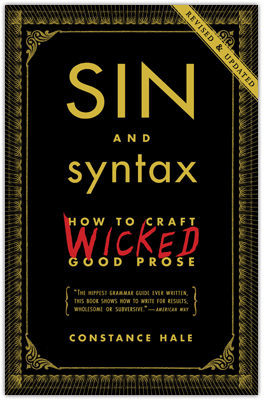
Sin and Syntax has been called a subversive grammar guide. But its purpose isn’t good grammar; it’s prose that makes us laugh, well up with tears, or just say “ahhhh.” Similarly, this Web site shares tips and resources, insights and inspiration—all in the interest of encouraging wicked good prose.
This blog brings you boneheaded errors and brilliant passages. It’s about showing how a deep sense of how English works saves us from comic errors, pompous pronouncements, and mere mediocrity. With that, let’s plunge into the peculiarities of prose….
In my last post, I wrote about seeing a performance of Mozart Dances by the Mark Morris Dance Group. A few days before that performance at the Boston Opera, I listened in on a conversation between Morris and Richard Dyer, a former music critic, which took place at Harvard University’s Sanders Theatre. I reported on that conversation with a group of Tweeting journalists #markmorris.
My ears perked up when a dance teacher asked the choreographer whether he ever feared being blocked, and what he did when he “dried up.” Morris described being creatively blocked as a kind of occupational hazard and offered some useful advice to any writer who suffers from occasional writer’s block.
Let me tell you about something I saw last night. Eighteen men and women, all lightly dressed in summer white, lay on a proscenium stage. From the floor, 36 naked hands bent at right angles from 36 wrists and wriggled up, each at a slightly different pace. Let me make sure you’ve got the picture: 36 splayed palms with urgently curled fingertips, turning clockwise and counterclockwise, clockwise and counterclockwise—as if working the lids of enormous and invisible upside-down jars—and at the same time lifting slowly, pushed upwards by long, lithe, tendril-like arms.
What did any of this have to do with writing?
Sitting in the cab of a pickup, waiting to drive up the coast of O‘ahu, I find myself watching a butterfly four feet in front of the windshield. My focus sharpens. The butterfly’s wings are like the iced feuilles of a French pastry—terribly thin slices of tangerine, edged in mocha. They raise and lower, raise and lower, forming two erect parallel planes, then two flat spans. The insect swoops and twitches…. I have been looking at this amazing bush of purple, green, and orange every day for a week. But I haven’t seen it.
If the tropics pry open the senses, they humble the writer. It’s one thing to discover the powers of perception, quite another to find powers of description. It can take days for my muscles to let go, longer for my senses to open, and even longer to connect words to images.
Didja catch two fascinating articles in last Sunday’s New York Times? In the Op-Ed pages, Farrar, Straus & Giroux publisher Jonathan Galassi writes about the heroic—and hidden—work behind great literature, and about the myopia of those infatuated with the idea of e-books.
David Carr, in “Why Twitter Will Endure,” confesses his own infatuation with Twitter.
In Talking Story, Shelly Runyon writes about the Twitter feed of Susan Orlean, and what it tells us about Orlean’s particular brand of short-burst communication.
I just read this article in the San Francisco Chronicle and had myself a snigger.
Tom Torriglia happily proclaims himself part of the grammar police, and he even started a group called NAGG (the National Association of Good Grammar).
But already I don’t trust him.
I spent the plane ride home to California correcting grammar exams. What fun! Seriously. This fall an intrepid group of Harvard expository-writing students followed me for 14 weeks on a romp through the nouns & verbs, simple sentences, and—eek!—relative clauses. We wrapped up by sorting through the sentences of Lewis Carroll. (Alice in Wonderland is great for prepositional phrases—all those ins, outs, downs, and throughs.) We also contemplated the comma, the semicolon, and other sundry pieces of punctuation.
I can’t end the year without a little contest for you, my readers. Wanna win a New Year’s present from me?
An intriguing collection of unlike things ends up on the New York Times list of 100 notable books each year. A recent article in the Columbia Journalism Review about the blurring of fiction and nonfiction claims that nonfiction is losing its “frisson.” I hardly agree—see my essay in Talking Story—but if you need further convincing, go no further than the NYT’s top 100.
Here is the Connie Cull…
I’ll bet you’ve had your fill this week of the former beauty queen, former mayor of Wasilla, former governor of Alaska, former vice-presidential candidate. I know I have. So while the pundits talk on and on about Sarah Palin, I space out and listen to their grammar.
I have to admit, I was surprised to hear Gwen Ifill and Bob Woodward, on ABC’s This Week, screw up their pronouns when discussing Going Rogue. It was the pronouns “going rogue” in their exchange.
The other day I was trying to impress upon a class of writers how cool it is that every sentence in English can be boiled down to one of four sentence patterns. They were having trouble grasping the second pattern, whose main elements are a subject, a transitive verb, and a direct object. That object thing was giving them heartburn.
I remembered a game—The Exquisite Corpse—the Surrealists used to play. In a twist of the parlor game Consequences—and its visual analogue, Picture Consequences—they would string random words together in a certain pattern. The resulting sentence sometimes flirted with rationality, but worked structurally.
I mentioned earlier that I’m auditing an English class at Harvard taught by literary critic James Wood. We’ve so far muscled our way through Saul Bellow, Vladimir Nabokov, V. S. Naipaul, and Henry Green. Now we are reading Netherland, by Joseph O’Neill. It’s an inspiring read in all sorts of ways, but one thing I noticed right away was the Irish-Turk-sort-of-American writer’s use of metaphors.
Take this description, right at the beginning of the book, written in the voice of the Dutch narrator: “It was the kind of barbarously sticky American afternoon that made me yearn for the shadows case by scooting summer clouds in northern Europe, yearn even for those days when you play cricket wearing two sweaters under a cold sky patched here and there by a blue tatter—enough to make a sailor’s pants, as my mother used to say.”
The sky is one of the hardest things to describe in a fresh way.
Barak Obama may be a damn good rhetoritician, but his politically correct use of pronouns is bugging me. Take this, from the July 22 press conference when he waded into the Henry Louis Gates-Sgt. Crowley brouhaha: “I think it’s fair to say, number one, any of us would be pretty angry; number two, that the Cambridge police acted stupidly in arresting somebody when there was already proof that they were in their own home.”
While pundits jumped on the President’s case for saying the Cambridge police acted “stupidly,” I muttered under my breath about his use of “they” when “he” or “she” was called for.
In case you haven’t noticed, each week I post a some writing and grammar exercises–an easy, self-guided writing class. Check out For Writers and Teachers, under Resources. I have a growing email list of teachers who receive once-a-week notes on using Sin and Syntax in the classroom. Please feel free to join us.
I tend to use this blog for thoughts on writing, but I’m feeling a pent-up desire to go grammatical. Next post: One of my biggest pet peeves and how I wish our Nobel-Peace-Prize-winning president didn’t mash his pronouns.
I’m fascinated with writing that uses the techniques of fiction to enliven nonfiction, whether in print, online, or on the radio or in documentary films.
Ken Burns is hard to ignore—not just because his The National Parks: America’s Best Idea preempted PBS prime-time programming last week—but also because he has the chops and the resources to do great narrative journalism. I mainly agreed with Mary McNamara’s LA Times review, but while watching endless footage of razorlike mountains and verdant plains, I couldn’t help muttering, “Does it have to be so long?” “Could the writing have more frisson?” “Can Ken Burns do tone that isn’t elegiac?”
I’ve always had a soft spot for William Safire. Of course, I’m too young to hold against him his swordsmanship as Richard Nixon’s speechwriter, especially since the phrases that survived—“nattering nabobs of negativism” and “hopeless, hysterical hypochondriacs of history”—seem more laughable than irksome. (Any wordsmith knows that alliteration should never be carried that far.) Even his nastier jabs—calling Hillary Clinton “a congenital liar”—lost their sting in the repartee that followed (a Clinton aide said that the chief of state, “if he were not president,” would have busted Safire’s nose; Safire parried by praising the use of the subjunctive.)
If you think I’m obsessed with point of view, you’re right! I am auditing a Harvard class taught by James Wood (also a critic for The New Yorker), who has been discussing point of view in novels by Saul Bellow and Vladimir Nabokov. And in the first lecture of the class, Postwar American and British Fiction, Woods suggested that we might “want to pick up some Flaubert” and look specifically at point of view. OK, so I devoured all 275 pages of Madame Bovary.
As far as playing with point of view, and not in blogs but in the pages of The New York Times and Rolling Stone, two of my favorite political journalists combine novel points of view with strong attitude and voice. They would be Mark Leibovich and Matt Taibbi.
I’ve been thinking about point of view. After all, what defines a blog if not point of view? A blog brings you one person’s prejudices, insights, and endless opinions. (Of course, the best blogs bring you much more—like new information, credible reporting, and, sometimes, bursts of brilliant writing.)
But a blog often comes alive because of another aspect of point of view, the literary aspect. The writer sets this point of view by his or her choice of pronouns—I, we, you, he, one, they. I’ve pondered what point of view to use here: The soul-bearing I? The inclusive we, which can also verge into the elegant “editorial we” or the arrogant “royal we”? Or the informal you, capable of sliding from authoritative, even bossy, to irreverent and hip?